CloudWatch RUM and Core Web Vitals (2026): When Real-User Data Beats Synthetics Alone
Quick summary: Synthetics prove a journey works from AWS; RUM shows what real browsers experience (LCP, CLS, INP). Sampling, privacy, cost, and when Application Signals still owns backend SLOs.
Key Takeaways
- Synthetics prove a journey works from AWS; RUM shows what real browsers experience (LCP, CLS, INP)
- On July 22, 2026, backend SLOs can be green while users on slow mobile networks still bounce
- CloudWatch RUM (Real User Monitoring) closes that gap by collecting Core Web Vitals (LCP, CLS, INP) and related page performance from real browsers
- Not front-end paint/layout | Opinion: Tier-1 products need all three on the same named journeys
- Setup 1
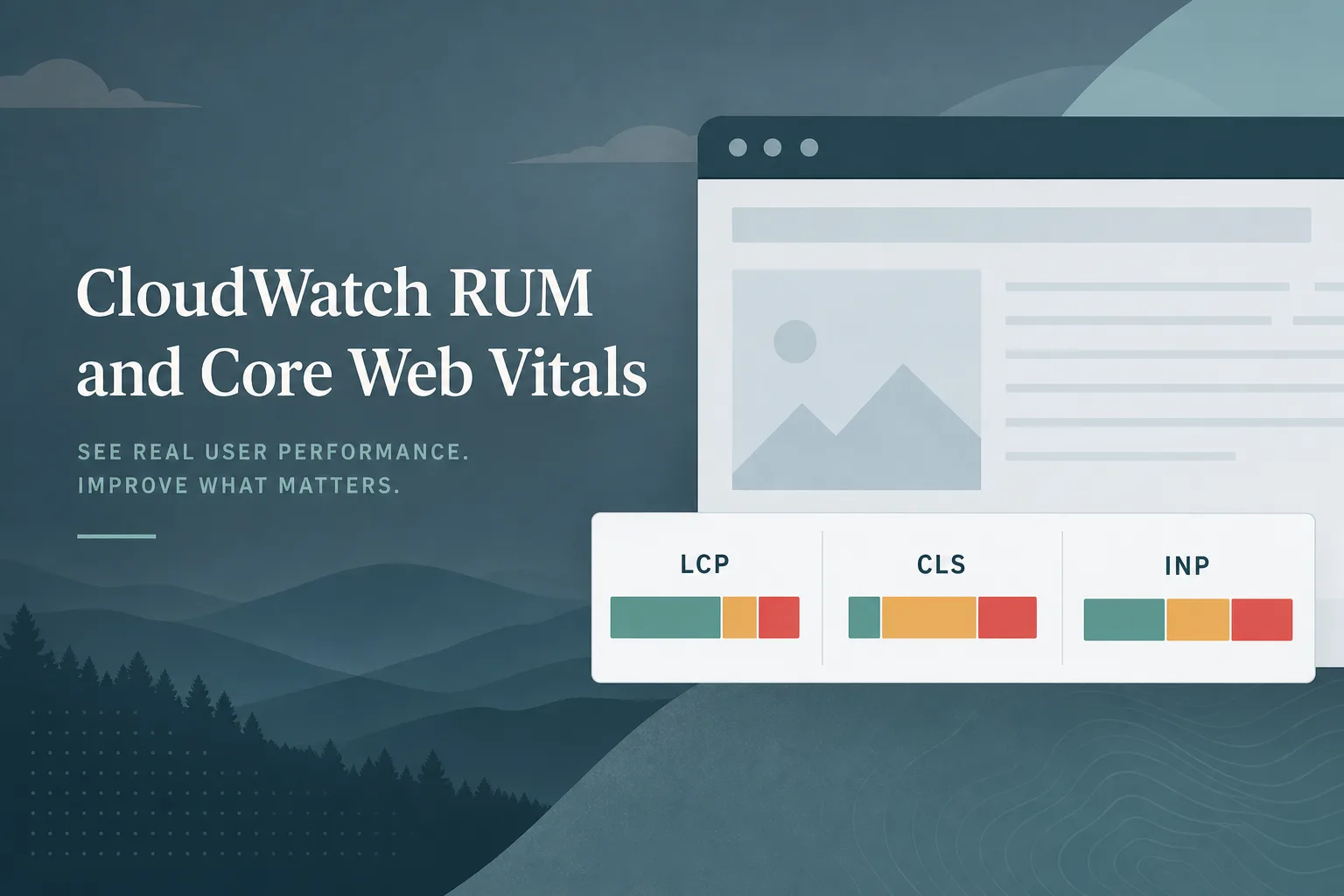
Table of Contents
On July 22, 2026, backend SLOs can be green while users on slow mobile networks still bounce. CloudWatch RUM (Real User Monitoring) closes that gap by collecting Core Web Vitals (LCP, CLS, INP) and related page performance from real browsers. It does not replace Synthetics canaries or Application Signals. It answers a different question: what did users actually experience?
RUM vs Synthetics vs Application Signals
| Signal | Answers | Blind spot |
|---|---|---|
| Synthetics | “Does the journey work from our probe?” | Not real devices/networks |
| RUM | “What did browsers measure?” | Sampling, blockers, low traffic |
| Application Signals | “Is the backend healthy?” | Not front-end paint/layout |
Opinion: Tier-1 products need all three on the same named journeys. Page primarily on Synthetics failures and Application Signals SLO burn, and use RUM for performance regressions and release gates (monitoring vs alerting).
Setup
- Create an app monitor per Region that serves traffic.
- Pin the web client version (snippet or package).
- Restrict to known domains.
- Set sampling deliberately and start conservative.
- Document Cognito / auth mode so credential rotation does not silently stop collection.
Core Web Vitals alarms
Alert on sustained regressions (for example LCP p75 above your budget for N periods), not single-session outliers. Tie release freezes to error budgets the same way you do for availability (SLA/SLO guide).
Cost
RUM is an event meter. Re-forecast after campaigns. Stack-level CloudWatch cost is still dominated by logs for many accounts. Use the observability stack calculator and CloudWatch pricing breakdown.
Privacy
Scrub tokens and emails from URLs and custom attributes. Respect consent banners. Treat RUM config as a security review item, not only a performance one.
What to do this week
- Decide if you have a front-end performance SLO (LCP/INP) worth measuring.
- Enable RUM with low sampling on production using the checklist.
- Correlate one slow page with Application Signals backend latency for the same API.
- Keep Synthetics as the availability page source of truth.
- Need implementation help? Managed services or contact us.
What this post doesn’t cover
- Full competitive matrix vs Datadog RUM / FullStory session replay.
- Mobile native (iOS/Android) RUM agents beyond web.
- Detailed CWV optimization techniques (image CDN, hydration), which is performance engineering beyond collection.
Frequently asked questions
What is CloudWatch RUM?
When should I NOT rely on RUM alone?
How does RUM differ from Application Signals?
What drives CloudWatch RUM cost?
What could go wrong with RUM privacy settings?
Should every SPA enable 100% RUM sampling?

Enterprise AI Transformation
Enterprise AI transformation and implementation leader focused on pilot-to-production playbooks, with a background in financial services. Writes the FactualMinds guides on serverless, CI/CD, and DevOps on AWS, the delivery plumbing production AI depends on.

 Kevin W.