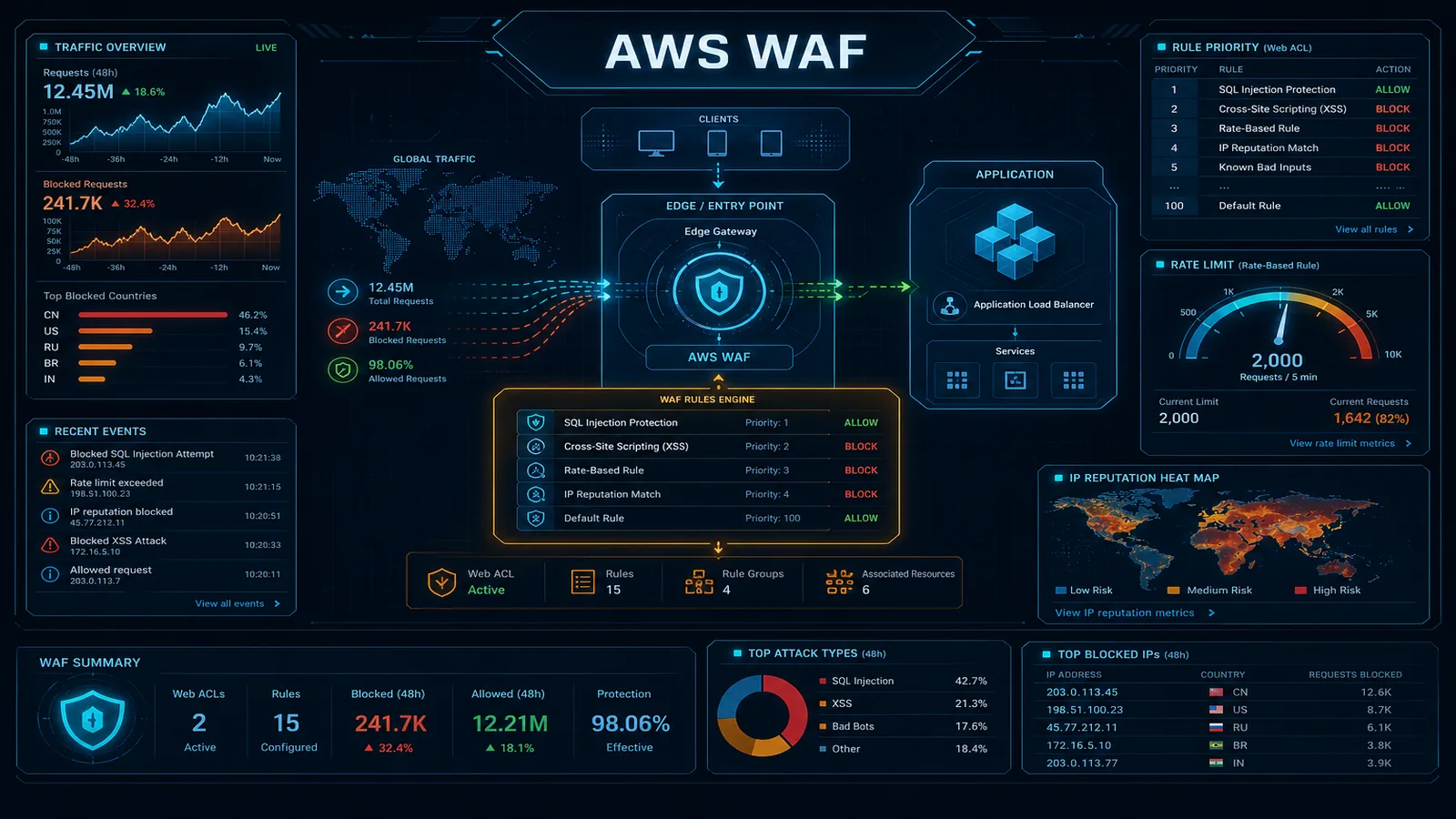
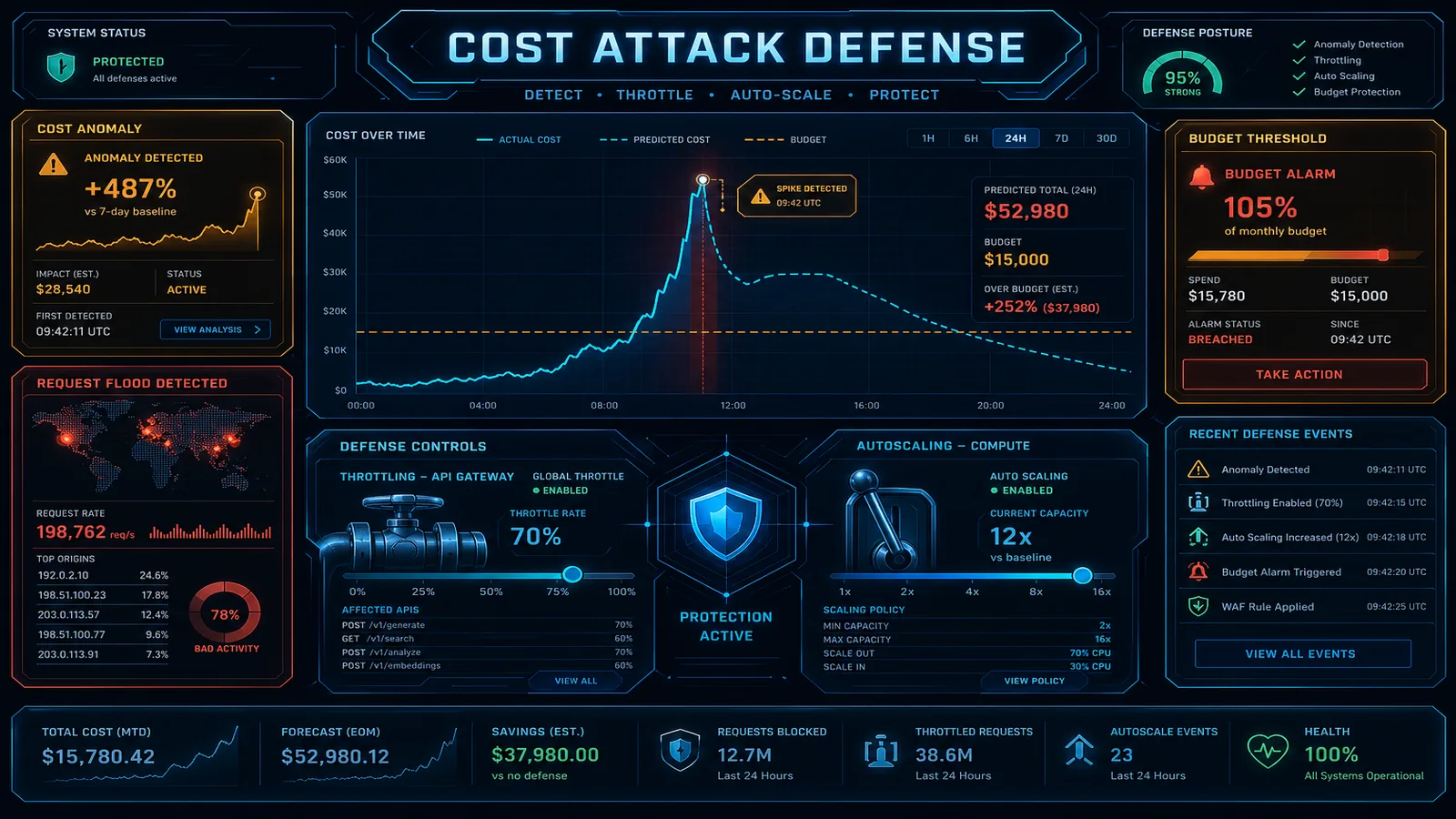
AWS Shield Advanced (2026): DDoS Response, Cost Protection, and Buyer Guide
Quick summary: Shield Advanced is $3,000/mo per org plus DTO fees. For a consumer marketplace (~180M req/mo CloudFront), cost protection credited $41k in scaling charges after a 38-minute L7 event when WAF rate rules were pre-configured.
Key Takeaways
- Shield Advanced is $3,000/mo per org plus DTO fees
- For a consumer marketplace (~180M req/mo CloudFront), cost protection credited $41k in scaling charges after a 38-minute L7 event when WAF rate rules were pre-configured
- For WAF rule design, see WAF production setup and API protection beyond basics
- Benchmark pattern (not a cited client): Consumer marketplace, ~180M CloudFront req/mo, prior L7 event 38 min, unprotected scaling bill $41k (DTO + LCUs)
- After Advanced + WAF rate Block rules: Shield cost protection credit approved $41k (eligibility met: protections pre-applied, credit requested within 15-day window)
Table of Contents
AWS Shield Advanced charges a $3,000/month fee per organization (consolidated billing payer) plus data transfer out usage fees on protected resources, with a 1-year subscription commitment (Shield pricing, Security Blog reference). Subscriptions include the L7 Anti-DDoS AWS managed rule group, automatic application-layer detection on protected CloudFront/ALB/Route 53 resources, and up to 50 billion AWS WAF requests per calendar month per payer (DDoS-detected requests are excluded from that cap) (Shield features).
This post is the Shield Advanced buyer guide, covering economics, SRT, and cost protection. For WAF rule design, see WAF production setup and API protection beyond basics.
Artifacts: decision matrix, DDoS runbook template, edge protection diagram (draw.io).
Shield Standard vs Advanced: decision frame
| Layer | Shield Standard (free) | Shield Advanced (paid) |
|---|---|---|
| L3/L4 network/transport | Yes, all customers | Enhanced automatic mitigation |
| L7 application | No | L7 AMR + optional SRT custom rules |
| Cost protection credits | No | Yes, with prerequisites |
| SRT proactive engagement | No | Business/Enterprise Support required |
| WAF on protected resources | Pay separately | Standard WAF fees included |
Opinionated take: Buy Advanced when DDoS scaling cost or reputational outage exceeds ~$36k/year (12 × $3k) and you will actually enable per-resource protection + WAF rate rules before the next event. Otherwise invest in WAF tuning and incident runbooks first.
Reference architecture
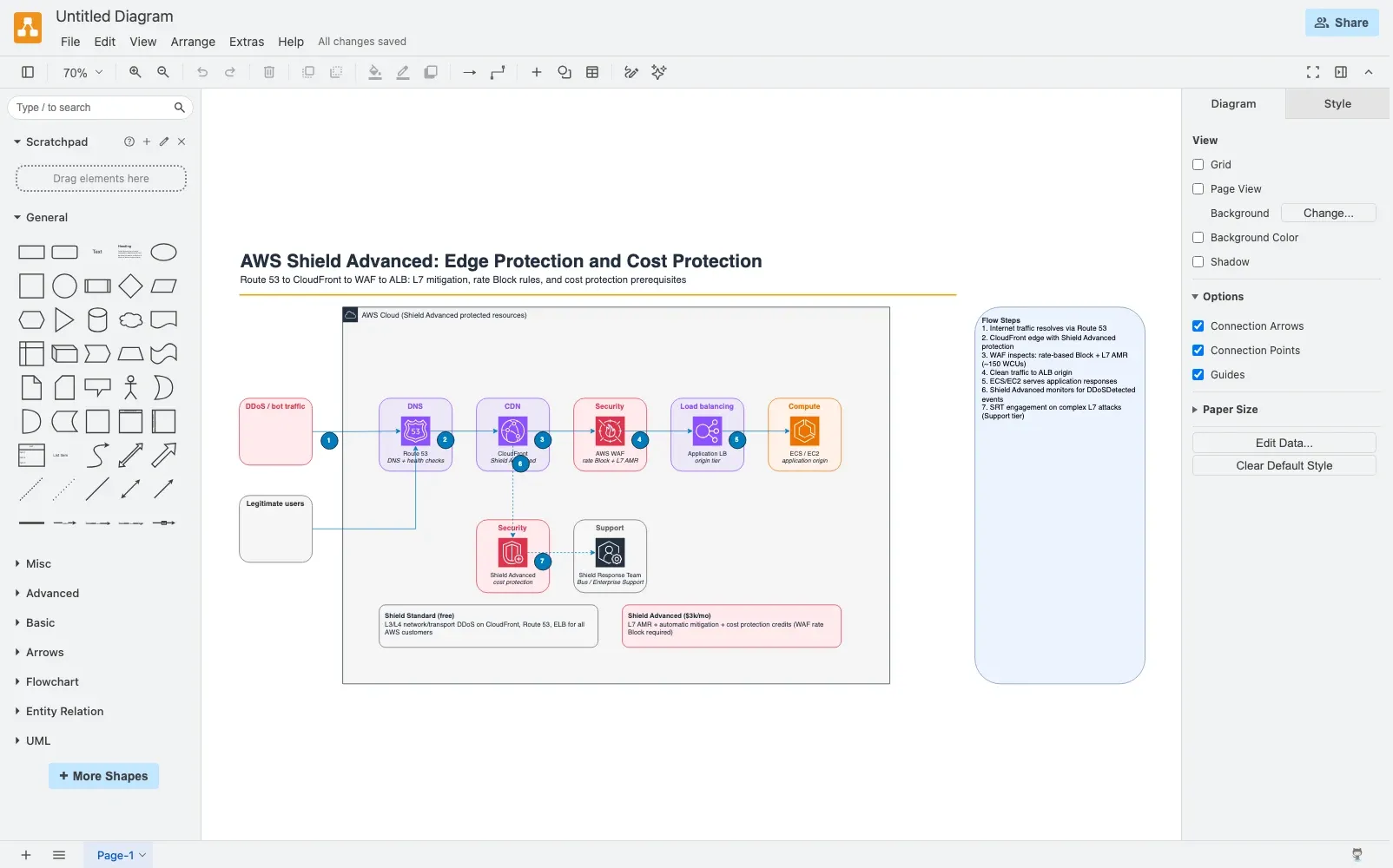
Figure: Route 53 → CloudFront (Shield Advanced) → WAF (rate Block + L7 AMR) → ALB → origin, with cost protection and SRT escalation. Open draw.io source
Internet ──► Route 53 ──► CloudFront (Shield Advanced) ──► WAF (rate Block + L7 AMR) ──► ALB ──► ECS/EC2
                              │                                    │
                              └── Shield Advanced cost protection ─┴── SRT (Business/Enterprise Support)
What Advanced includes (2026)
Per AWS WAF developer guide — deciding on Advanced:
- Automatic application layer DDoS mitigation adds ~150 WCUs via managed rule group
- 50 billion WAF requests/month/payer on Shield-protected resources; overage billed per Shield pricing
- DDoS cost protection: request credits for eligible scaling charges after documented attacks (credit process)
Eligible credit charge types include Shield Advanced DTO, CloudFront requests/data transfer, Route 53 queries, Global Accelerator transfer, ALB LCUs, and EC2 instances launched by ASG during attack.
SRT: Shield Response Team
From Shield features:
- Business or Enterprise Support required to contact SRT
- SRT can apply custom WAF rules with your permission during complex L7 attacks
- Automatic mitigations deploy for many L3/L4 events without ticket
Run ddos-runbook-template.md in tabletop before purchase and confirm support tier and escalation phone tree.
Cost protection: prerequisites checklist
Before any attack (AWS docs):
- Shield Advanced protection enabled on each resource: the account subscription alone is insufficient
- CloudFront / ALB: WAF web ACL with rate-based rule in Block mode
- Implement DDoS resiliency best practices
- File credit request within 15 days after the billing month containing the attack
WAF relationship: do not double-pay blindly
Advanced covers standard WAF on Shield-protected resources (web ACL, rules, base request inspection up to 1,500 WCUs). It does not cover:
- Bot Control, CAPTCHA actions, >1,500 WCUs
- WAF on resources not Shield-protected
Pair with rate limiting patterns and cost-based attack protection.
When NOT to buy
| Situation | Recommendation |
|---|---|
| Internal ALB only (corp VPN) | Shield Standard + security groups |
| Already on dedicated scrubbing CDN | Compare TCO; avoid duplicate |
| Developer Support only | Upgrade support before Advanced if SRT is the value |
| No ops owner for WAF rate rules | Fix WAF first; credits require Block mode |
What to Do This Week
- Run shield-advanced-decision-matrix.md with FinOps + security.
- Inventory internet-facing CloudFront, ALB, Route 53, Global Accelerator and mark Shield protection status per resource.
- Verify WAF rate-based rules are Block, not Count, on public edges.
- Confirm Business/Enterprise Support if SRT is in the business case.
- Schedule DDoS tabletop using ddos-runbook-template.md.
What This Post Doesn’t Cover
- AWS Firewall Manager org-wide WAF policy design: see WAF guide
- GuardDuty threat detection: complementary to Shield, not a substitute
- Third-party CDN DDoS (non-CloudFront): vendor-specific
- Legal/regulatory breach notification: incident response runbooks
We have not validated cost protection credit approval rates. AWS evaluates each request, and the prerequisites above are necessary but not sufficient.
Related: Cloud security services · Managed SOC/MDR · Penetration testing
Frequently asked questions
When is Shield Standard enough without Advanced?
When should we NOT buy Shield Advanced?
What does SRT require beyond the $3,000 subscription?
Does Shield Advanced replace AWS WAF?
What breaks cost protection credit eligibility?
How does this relate to the WAF production guide?

Agentic AI & Cloud Security
Works on making teams more productive with agentic AI. Writes the FactualMinds guides on AWS security and compliance: identity, threat detection, data protection, and audit readiness, the controls AI agents need before they touch production systems.