Implementing GenAI Guardrails: A Guide to Secure AI Governance in AWS Environments
Quick summary: Deploying GenAI without guardrails is a compliance incident waiting to happen. This post covers how to build a production-grade AI governance layer on AWS using Amazon Bedrock Guardrails, least-privilege IAM, and continuous evaluation.
Key Takeaways
- This post covers how to build a production-grade AI governance layer on AWS using Amazon Bedrock Guardrails, least-privilege IAM, and continuous evaluation
- AWS lifecycle notice (June 30, 2026): Amazon Bedrock Agents is now Bedrock Agents Classic, in maintenance for new customers after July 30, 2026
- Net-new agent builds should use Bedrock AgentCore
- In November 2025, 1 in every 35 GenAI prompts carried a high risk of sensitive data leakage, affecting 87% of enterprises using AI regularly
- Gartner projects that 40% of AI data breaches by 2027 will stem from cross-border GenAI misuse

Table of Contents
In November 2025, 1 in every 35 GenAI prompts carried a high risk of sensitive data leakage, affecting 87% of enterprises using AI regularly. While teams race to ship AI features, the default posture for most deployments is permissive: no output filters, no PII redaction, no hallucination checks. A raw LLM call sits between your business logic and your customers, and that is a liability.
The Gap Between “Working” and “Production-Ready” GenAI
Moving a GenAI application from prototype to production requires control as well as performance. In regulated industries, an AI system that generates factually incorrect medical advice or leaks a customer’s SSN in a chatbot response has created a compliance incident, not just a bug.
Gartner projects that 40% of AI data breaches by 2027 will stem from cross-border GenAI misuse. Meanwhile, 22% of files uploaded to GenAI tools already contain sensitive data: source code, access credentials, M&A documents, customer records. The exposure vector is growing.
Build the guardrail layer properly from day one rather than slowing GenAI adoption. As of 14 July 2026, start from Security Hub AI inventory so Guardrails policy scope covers every managed, self-hosted, and external model path you actually run.
What Amazon Bedrock Guardrails does
Amazon Bedrock Guardrails is the safety layer for Bedrock model invocations. It blocks up to 88% of harmful content and delivers auditable, mathematically verifiable explanations for validation decisions with 99% accuracy. Its controls:
- Content filtering: Blocks harmful text and image content across six categories: hate speech, insults, sexual content, violence, misconduct, and prompt injection attacks.
- Topic denial: Prevents the model from responding to off-topic requests. A procurement assistant should not be dispensing legal advice, and you can enforce that at the infrastructure level.
- Sensitive information redaction: Automatically masks or blocks PII (SSNs, credit card numbers, email addresses) before it reaches the model or the end user.
- Grounding checks: Detects hallucinations by verifying that model responses are anchored in your source data. Since October 20, 2026, a Standard tier also handles reasoning and conversational responses at the same price as Classic (cross-Region inference required). This matters for RAG-based architectures, which are now the primary vector for enterprise prompt leakage.
- Automated Reasoning checks: The first GenAI safeguard to use formal logic for response validation. Up to 99% accuracy, with auditable proof, which matters for healthcare and financial services deployments.
Guardrails also work across any foundation model via the ApplyGuardrail API. Whether you are running Claude on Bedrock, an OpenAI model, or a self-hosted Llama model, the same controls apply. That helps if your architecture spans multiple model providers, which most enterprise architectures eventually do.
Model update (March 2026): AI models have changed since this guidance was written. Apply these guardrail principles to current-generation models:
- Claude on Bedrock: As of September 2026, current models are Claude Opus 5.5 (September 22, 2026) and Claude Sonnet 5.5 (September 28, 2026), both with 1M token context windows; Guardrails is supported on the
bedrock-runtimeendpoint. Bedrock is HIPAA-eligible, so confirm each model is in scope for your BAA before routing PHI.- OpenAI in enterprise: GPT-4 has been retired. ChatGPT Enterprise now runs GPT-5.4 (March 2026). The
ApplyGuardrailAPI approach remains valid for any OpenAI-compatible endpoint.- Self-hosted open-weight models: Llama 4 Maverick/Scout (Meta, April 2025) is the current generation, replacing Llama 3. Guardrail principles are model-agnostic and apply equally.
The core guardrail architecture described in this article is model-version-agnostic: these controls apply regardless of which model generation you deploy.
Least privilege for AI agents
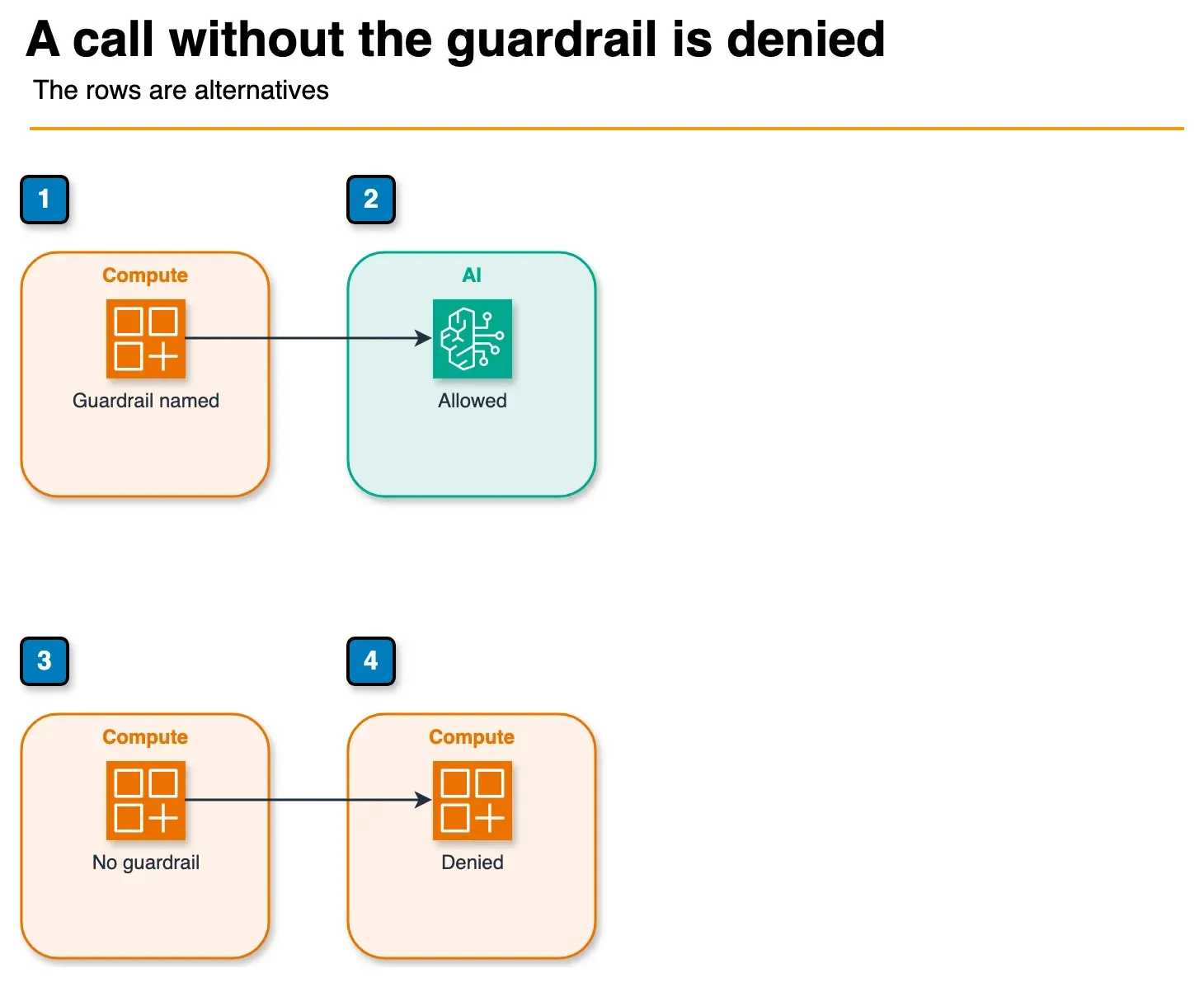
Figure: the IAM condition in the article. The rows are alternatives. A call that names the guardrail is allowed. A call without it is denied. Role actions stay scoped to what the agent actually does. The condition key stays in the article. Open the draw.io source.
If you are running Bedrock Agents Classic, or planning to, access control needs rethinking. AI agents take actions: reading from S3, writing to DynamoDB, invoking Lambda functions. A compromised or misbehaving agent can do real, irreversible damage.
In March 2025, AWS added the bedrock:GuardrailIdentifier IAM condition key, allowing you to enforce that specific guardrails are always applied at the policy level, as well as at the application level. This closes a gap: developers cannot accidentally deploy a Bedrock endpoint without the required guardrail attached.
The AWS Prescriptive Guidance for GenAI Agents says each agent should run under a custom IAM role scoped to the minimum permissions it actually needs (bedrock:InvokeAgent, dynamodb:GetItem, lambda:InvokeFunction) and nothing more. Amazon Bedrock AgentCore Identity extends this further with a secure token vault using customer-managed KMS keys, binding credentials to specific agent-user pairs and preventing cross-user credential sharing entirely.
Enterprise-scale governance: one policy, every account
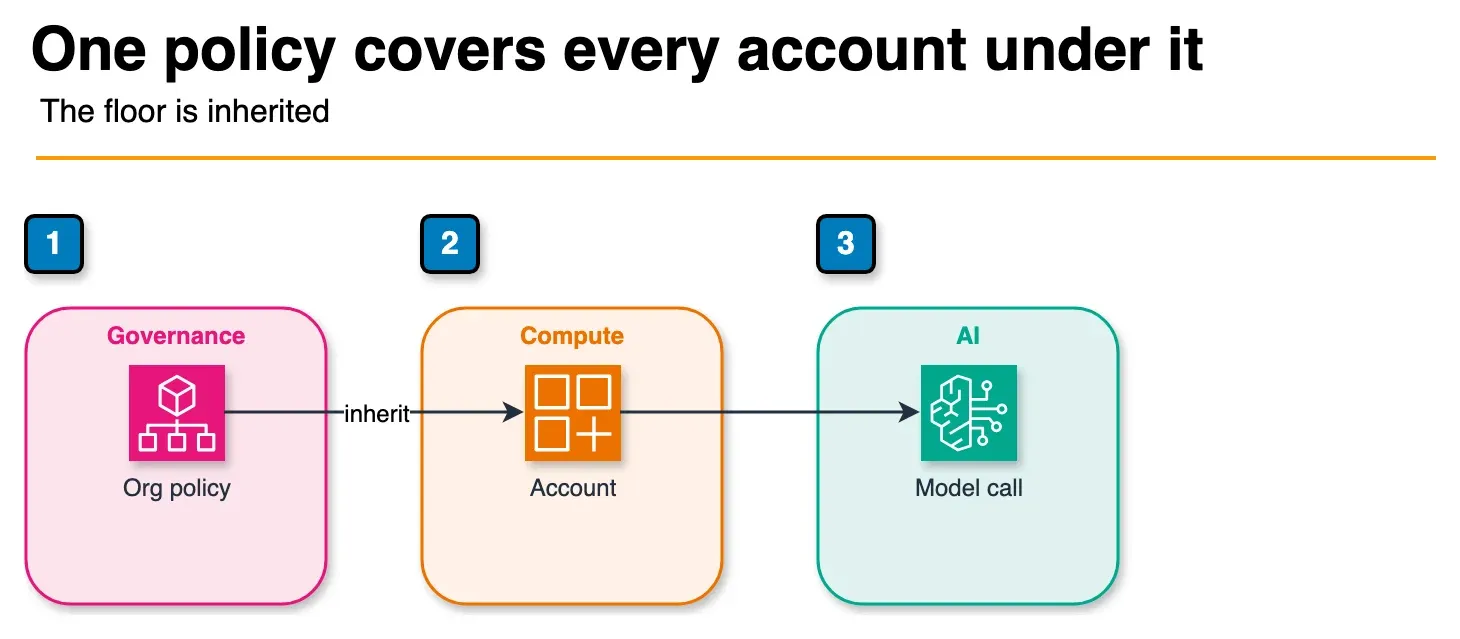
Figure: organizational guardrail policies in the article. A policy on an Organizations node applies to the accounts under it, and those controls apply to model calls. The request path through a guardrail is an earlier diagram. Open the draw.io source.
Governance does not scale if every team configures guardrails independently. AWS addresses this with Amazon Bedrock organizational policies: attach a single guardrail configuration to any node in your AWS Organizations structure, and every account beneath that node automatically inherits it, applying those controls to every model inference call.
Your security team defines the floor once: content policies, topic restrictions, PII handling rules. Every GenAI application built across the organization gets those controls enforced automatically, so a developer cannot ship an LLM integration without content filtering just because they did not know they needed it.
For CTOs managing large engineering organizations, this reduces operational overhead: centralized governance without centralized bottlenecks.
Continuous guardrail evaluation
At AWS re:Invent 2025, Amazon introduced AgentCore Evaluations: 13 pre-built evaluators covering correctness, helpfulness, safety, and behavioral consistency, running continuously against live agent interactions. This turns AI governance from a launch-time checklist into an ongoing observability practice.
For DevOps leads, this is the self-healing infrastructure model applied to AI. When agent behavior regresses (outputs become less accurate, safety scores drop, hallucination rates climb), you catch it in monitoring dashboards, not in a customer complaint. Build alerts on guardrail metric trends the same way you build them on p99 latency or error rates. Automate rollback when evaluation scores fall below threshold. Treat AI behavioral regression as a deployment failure, because it is one.
Compliance coverage
Amazon Bedrock is in scope for ISO, SOC, CSA STAR Level 2, GDPR, FedRAMP High, and is HIPAA eligible. Data is encrypted in transit and at rest. Model providers never see your data. Guardrails generate the audit logs that regulators want to see: a complete, queryable record of what the model was asked, what it responded, and what was filtered.
If you are building AI in healthcare, finance, or federal-adjacent contexts, this compliance posture is what makes the deployment legally defensible.
Where to start
We recommend this implementation sequence for most enterprise deployments:
- Enable content filtering and PII redaction first: Zero-regret changes. Turn them on for every model endpoint before anything else.
- Define topic restrictions specific to your application. Hard-code the boundaries of what your AI is allowed to discuss.
- Add grounding checks to every RAG pipeline. Your retrieval layer is in scope for your security model.
- Enforce guardrails at the IAM layer using
bedrock:GuardrailIdentifier. Remove the possibility of an application-level bypass. - Publish organizational guardrail policies in AWS Organizations to make baseline controls automatic and account-wide.
- Wire AgentCore Evaluations into your CI/CD pipeline so behavioral regression testing runs on every deployment.
This is the same pattern that made security work in DevOps: shift it left, make it structural, make it automatic. Make GenAI governance an architecture decision before your first production inference call, because retrofitting it after launch is harder.
If you are already running Bedrock workloads without a formal guardrail strategy, start with step 1. If you are evaluating GenAI for your organization, use this sequence as the blueprint. Either way, talk to our team about building a governance architecture that is right-sized for your AWS environment.
Related reading
Frequently asked questions
What does Amazon Bedrock Guardrails do?
Can Bedrock Guardrails work with non-Bedrock models?
How do I enforce Bedrock Guardrails at the IAM layer?
How do I apply Bedrock Guardrails across an AWS Organization?
What does Bedrock AgentCore Evaluations do?

AWS Cloud Architect & AI Expert
AWS-certified cloud architect and AI expert with deep expertise in cloud migrations, cost optimization, and generative AI on AWS.