GPT-6 Sol and Luna on Amazon Bedrock (September 2026): Routing Guide
Quick summary: On September 22, 2026 AWS made GPT-6 Sol and GPT-6 Luna generally available on Bedrock. OpenAI’s internal eval found Sol makes about half as many factual mistakes as GPT-5.6 Sol. GPT-6.1 Sol followed on September 29, Ultrafast on October 8, and GPT-6.1 Terra on October 26 at half the price of 6.1 Sol. This post covers the lane routing.
Key Takeaways
- On September 22, 2026 AWS made GPT-6 Sol and GPT-6 Luna generally available on Bedrock
- OpenAI’s internal eval found Sol makes about half as many factual mistakes as GPT-5.6 Sol
- GPT-6.1 Sol followed on September 29, Ultrafast on October 8, and GPT-6.1 Terra on October 26 at half the price of 6.1 Sol
- AWS lifecycle notice (June 30, 2026): Amazon Bedrock Agents Classic is in maintenance for new customers after July 30, 2026
- Net-new agent builds should use Bedrock AgentCore
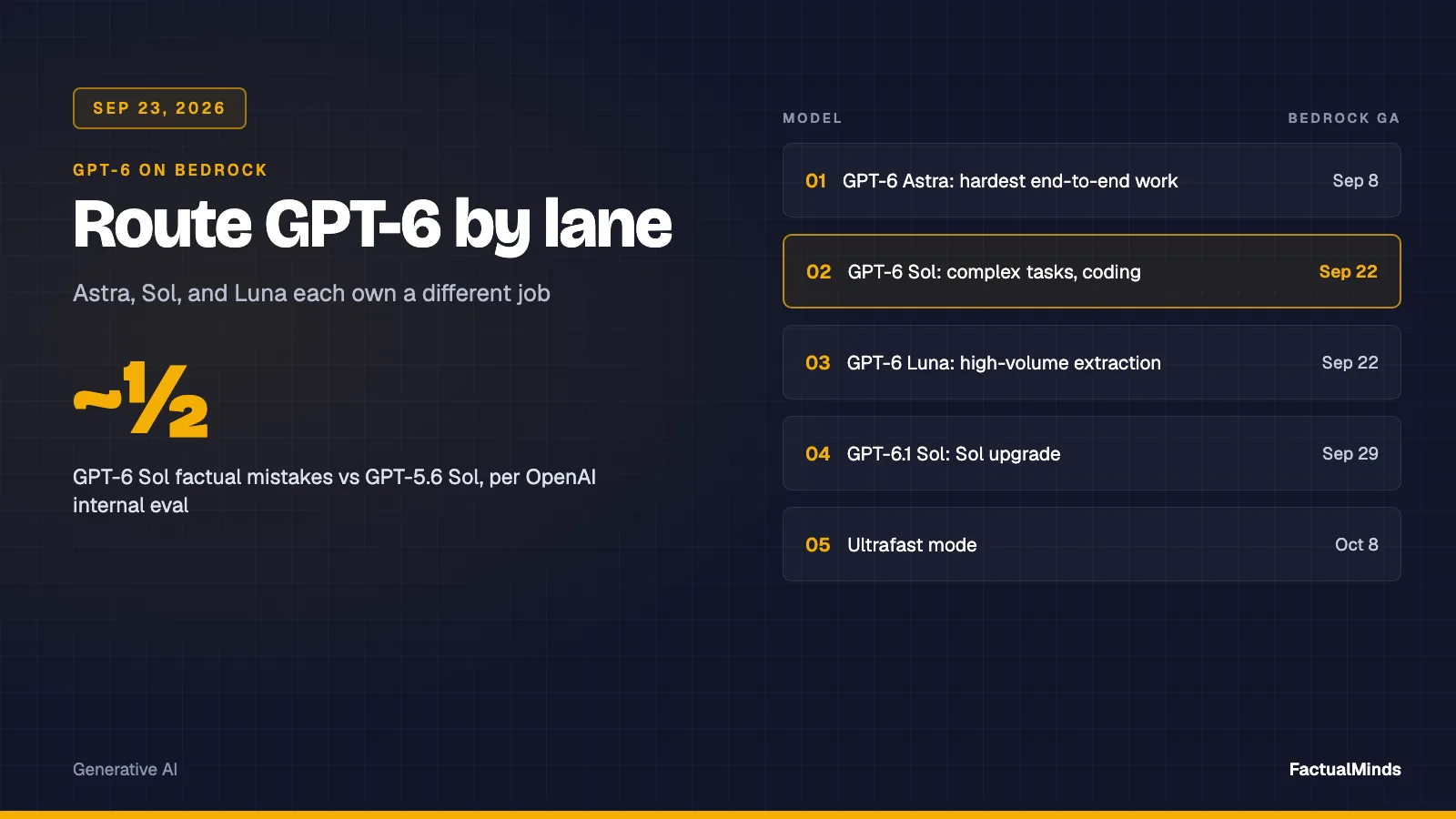
Table of Contents
On September 22, 2026, AWS made GPT-6 Sol and GPT-6 Luna generally available on Amazon Bedrock. The Machine Learning Blog post positions them under GPT-6 Astra, which was already the top of the family. Sol is the daily model for recurring complex work. Luna is the high-volume model. On an internal OpenAI factuality evaluation, Sol makes roughly half as many mistakes as GPT-5.6 Sol.
This is a routing event on top of the July 30, 2026 GPT-5.6 price cuts. Do not flip production model IDs because the family number changed.
New lane: GPT-6.1 Terra (October 26, 2026)
What AWS changed: on October 26, 2026, GPT-6.1 Terra became generally available on Amazon Bedrock. It is the first Terra in the GPT-6 family. There was no GPT-6 Terra. AWS positions it for everyday work that needs more than Luna and less than Sol. Per the model card: text and image input, 1,050,000-token context, 128,000 max output tokens. The card lists the Standard tier only. Priority, Flex, and Reserved are marked unsupported, and Ultrafast is not listed.
| Endpoint | Model ID | APIs |
|---|---|---|
| bedrock-mantle, us-east-1 | openai.gpt-6.1-terra | Responses, Chat Completions (/openai/v1) |
| bedrock-runtime, US Geo CRIS | us.openai.gpt-6.1-terra | Responses, Chat Completions, Converse, Invoke |
| bedrock-runtime, Global CRIS | global.openai.gpt-6.1-terra | Responses, Chat Completions, Converse, Invoke |
Per 1M tokens, 272K input tokens or fewer, Standard: $1.10 input, $1.375 cache write, $0.055 cache read, $5.50 output on Mantle and US Geo, and $1.00 / $1.25 / $0.05 / $5.00 on Global CRIS. Above 272K input tokens the whole request moves to $2.20 / $8.25 on Mantle and US Geo, and $2.00 / $7.50 on Global CRIS.
Against GPT-6.1 Sol on US Geo ($2.20 / $11.00), that is half on input and half on output. Against the GPT-5.6 Terra Bedrock rate ($2.20 / $13.20 after the July cut), input drops 50% and output drops 58%. AWS says “at least 50% lower” than both. The arithmetic agrees.
What the launch claims: on OpenAI’s Agents’ Last Exam, GPT-6.1 Terra scored 15 percentage points above GPT-5.6 Terra, performed on par with GPT-6 Astra, and completed tasks more than three times faster than Astra and GPT-6.1 Sol. OpenAI also cites gains in visual reasoning, computer use, factuality, and writing. These are OpenAI’s numbers, not ours. AWS adds that ChatGPT Work and Codex can be configured to call the model on Bedrock.
The catch:
- Name a profile on bedrock-runtime. There is no in-Region call there. Use
us.openai.gpt-6.1-terraorglobal.openai.gpt-6.1-terra. The IAM identity also needsbedrock:InvokeModelon the account’s default project (arn:aws:bedrock:{region}:{account-id}:project/default), not just on the inference profile. A policy copied from a GPT-5.6 lane can fail on that line alone. - EU and APAC callers get Global CRIS only. The US Geo profile covers US and Canada source Regions. Frankfurt, Ireland, Tokyo, Sydney, and the other listed EU and APAC Regions show Global only. São Paulo and Bahrain show nothing. If the lane has a residency requirement, Terra is not an option there yet.
- Converse rejects documents. A
documentcontent block, or an image inside atoolResult, returnsValidationException. Send files through the Responses API asinput_file. - Features split by API. Explicit prompt caching is Responses-only. Guardrails and application inference profiles are Converse-only. A lane that needs both Guardrails and explicit caching has to pick one.
- Quota burns 10× on output, same as 6.1 Sol. Check tokens-per-minute before moving a long-output agent lane.
- “On par with Astra” is one agent eval. It is a reason to put Terra in the Astra bakeoff, not a reason to retire Astra lanes.
Routing: new agent, computer-use, and document-reading lanes start their bakeoff with 6.1 Terra, because it costs half of 6.1 Sol. Keep GPT-5.6 Terra as the prior Terra pin. Keep 6.1 Sol where the coding pass rate still needs it.
Successor: GPT-6.1 Sol (September 29, 2026)
What AWS changed: on September 29, 2026, GPT-6.1 Sol became available on Amazon Bedrock. Per the model card: text and image input, 1M context, 131,072 max output tokens. The card lists Standard and Ultrafast. Ultrafast (October 8, 2026) is the same model: set "service_tier": "ultrafast" on the Responses API. Priority and Flex are still unsupported.
| Endpoint | Model ID | APIs |
|---|---|---|
| bedrock-mantle, us-east-1 | openai.gpt-6.1-sol | Responses, Chat Completions (/openai/v1) |
| bedrock-runtime, US Geo CRIS | us.openai.gpt-6.1-sol | Responses, Chat Completions, Converse, Invoke |
| bedrock-runtime, Global CRIS | global.openai.gpt-6.1-sol | Responses, Chat Completions, Converse, Invoke |
Per 1M tokens, 272K input tokens or fewer, Standard: $2.20 input, $2.75 cache write, $0.11 cache read, $11.00 output on Mantle and US Geo, and $2.00 / $2.50 / $0.10 / $10.00 on Global CRIS. Above 272K input tokens the whole request moves to $4.40 / $16.50 on Mantle and US Geo, and $4.00 / $15.00 on Global CRIS.
Ultrafast costs six times Standard. Short context: $13.20 / $66.00 on Mantle and US Geo, $12.00 / $60.00 on Global CRIS. Above 272K input tokens the whole request moves to $26.40 / $99.00 on Mantle and US Geo, and $24.00 / $90.00 on Global CRIS. The October 8 notice names the tier for latency-sensitive coding assistants, interactive agents, and customer-facing experiences. It does not publish a speed multiplier.
What the launch claims: OpenAI says GPT-6.1 Sol approaches GPT-6 Astra on demanding evaluations at roughly one-fifth of the cost per task. The ML Blog post says it matches Astra on DeepSWE v1.1 and beats the best GPT-6 Sol score by 6.4 percentage points. These are OpenAI’s numbers, not ours.
The catch:
- No direct in-Region call on bedrock-runtime. Mantle stays
us-east-1. Global CRIS isglobal.openai.gpt-6.1-sol. The October 8 notice does not say when Global CRIS shipped; the model card lists it. - Prompt caching. The model card lists implicit and explicit prompt caching. Explicit mode needs a prefix of at least 1,024 tokens, TTL 30 minutes, and at most four cache writes per request. Do not budget on cache hits until a test request shows cached tokens in the usage block.
- Quota burns 10× on output. Each output token uses 10 tokens of quota. Check the account’s token-per-minute quota before moving a long-output coding lane.
Keep GPT-6 Sol as the prior Sol pin. Move a US coding lane to 6.1 only after a frozen-prompt bakeoff on cost per completed task. Keep Astra for the jobs where 6.1 still fails.
What each model is for
AWS and OpenAI describe four GPT-6 jobs:
| Model | Job | Bedrock status |
|---|---|---|
| GPT-6 Astra | Hardest end-to-end work: complex reasoning, coding, computer use, research, document creation | GA September 8, 2026. Model card: openai.gpt-6-astra. Mantle in us-west-2. Runtime profiles us.openai.gpt-6-astra and global.openai.gpt-6-astra. Context 1,050,000 tokens. Max output 128,000. |
| GPT-6 Sol | Recurring complex tasks and software development: implement, debug, review, refactor, analyze data, multistep tools | GA September 22, 2026. About half as many factual mistakes as GPT-5.6 Sol on OpenAI’s internal factuality eval. |
| GPT-6.1 Terra | Everyday work between Luna and Sol: drafting, reading technical drawings, investigating codebases, agents that work across business systems | GA October 26, 2026. Half the GPT-6.1 Sol rate. Context 1,050,000 tokens. Max output 128,000. |
| GPT-6 Luna | High-volume extraction, summarization, classification, and routing, with adjustable reasoning effort | GA September 22, 2026. OpenAI reports better factual reliability than the prior Luna; the announcement does not publish a second numeric eval. |
Both Sol and Luna support up to 1M tokens of context on Bedrock (AWS). OpenAI’s API docs list a 1,050,000-token window for gpt-6-sol. Treat the Bedrock ceiling as the model card’s number once that card is in front of you. The two figures are close but not identical.
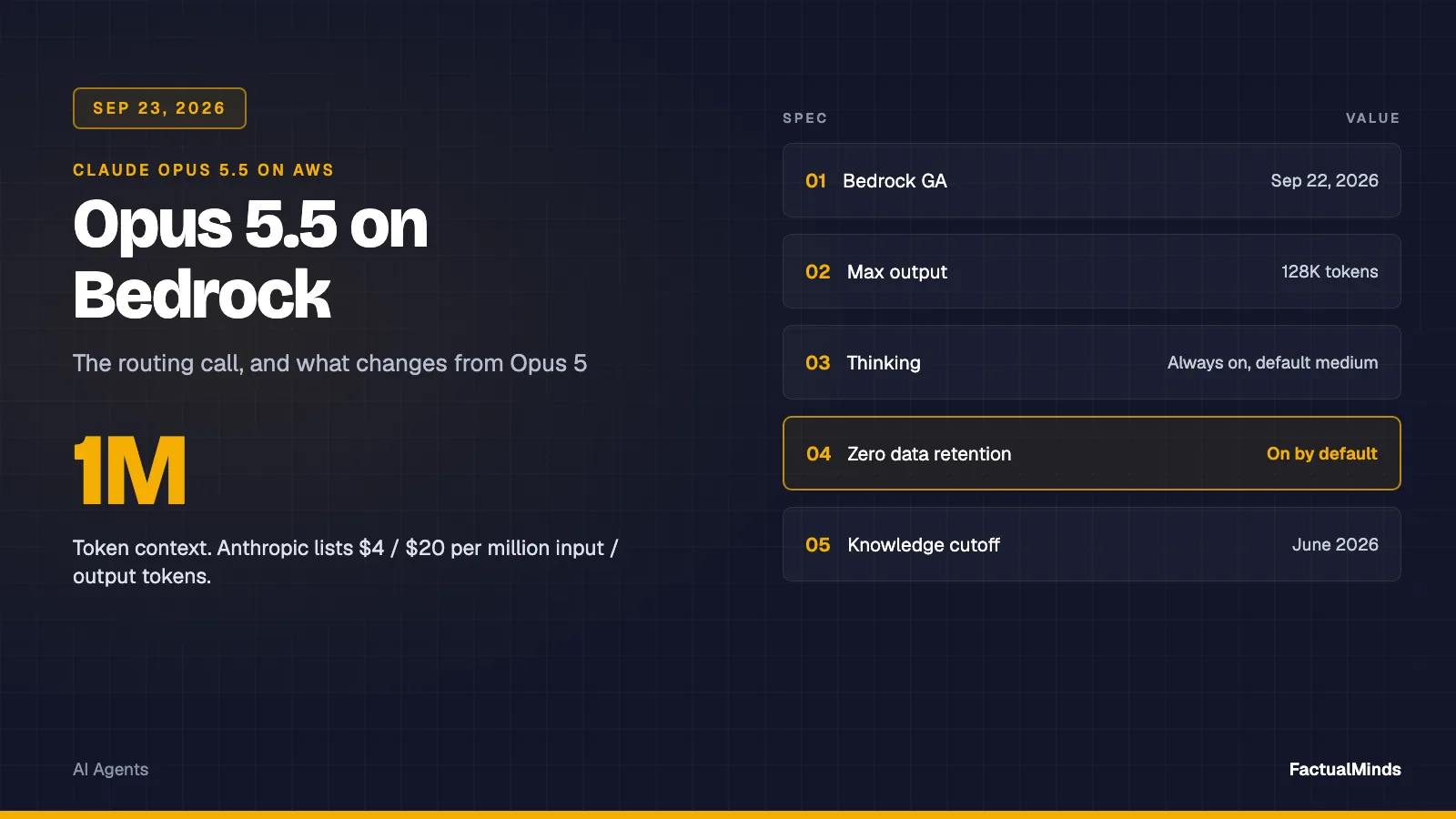
Opinionated take: new high-QPS classification, extraction, and routing go to GPT-6 Luna. New recurring coding and multistep tool lanes go to GPT-6 Sol. The hardest OpenAI jobs go to GPT-6 Astra. Keep GPT-5.6 Terra and Sol until a frozen-prompt bakeoff says the GPT-6 lane wins on quality and cost per completed task. Keep ZDR-default Claude work on Opus 5.5, not on an OpenAI model, when Guardrails composition and default zero data retention are the requirement.
Model IDs and endpoints
OpenAI’s Amazon Bedrock guide (checked September 23, 2026):
| Model | Mantle (in-region) | Runtime geo | Runtime global |
|---|---|---|---|
| Sol | openai.gpt-6-sol in us-east-1 | us.openai.gpt-6-sol | global.openai.gpt-6-sol |
| Luna | openai.gpt-6-luna in us-east-1 | us.openai.gpt-6-luna | global.openai.gpt-6-luna |
| Astra | openai.gpt-6-astra in us-west-2 | us.openai.gpt-6-astra | global.openai.gpt-6-astra |
Mantle base URL: https://bedrock-mantle.{region}.api.aws/openai/v1. Runtime base URL: https://bedrock-runtime.{region}.amazonaws.com/openai/v1, and the model name must be the inference profile, not the bare openai.gpt-6-sol ID. Hosted web search is Mantle-only. Background mode is Mantle-only and depends on data-retention settings. A region in the URL is not a data-residency guarantee; read the destination regions of the profile.
Context: OpenAI Python SDK, Mantle, us-east-1, Bedrock bearer token.
import os
from openai import OpenAI

client = OpenAI(
    api_key=os.environ['AWS_BEARER_TOKEN_BEDROCK'],
    base_url='https://bedrock-mantle.us-east-1.api.aws/openai/v1',
)

response = client.responses.create(
    model='openai.gpt-6-sol',
    input='Summarize the failure modes in this migration plan and list what you could not confirm.',
)
print(response.output_text)
For Runtime in the same region, point base_url at https://bedrock-runtime.us-east-1.amazonaws.com/openai/v1 and set model to us.openai.gpt-6-sol or global.openai.gpt-6-sol. The guide’s older samples still show openai.gpt-5.6-sol in us-east-2. Changing only the model ID, and leaving the region, is the failure mode.
Prompt caching and a three-model route
AWS says GPT-6 Sol and Luna support explicit prompt caching (GPT-6.1 Sol: the model card lists explicit caching with a 1,024-token minimum). Mark stable instructions, tool definitions, policies, and extraction schemas so later calls process the new input. That matters when one request is classified by Luna, investigated by Sol, and escalated to Astra, and each stage can reuse its own cached prefix instead of re-sending the policy pack.
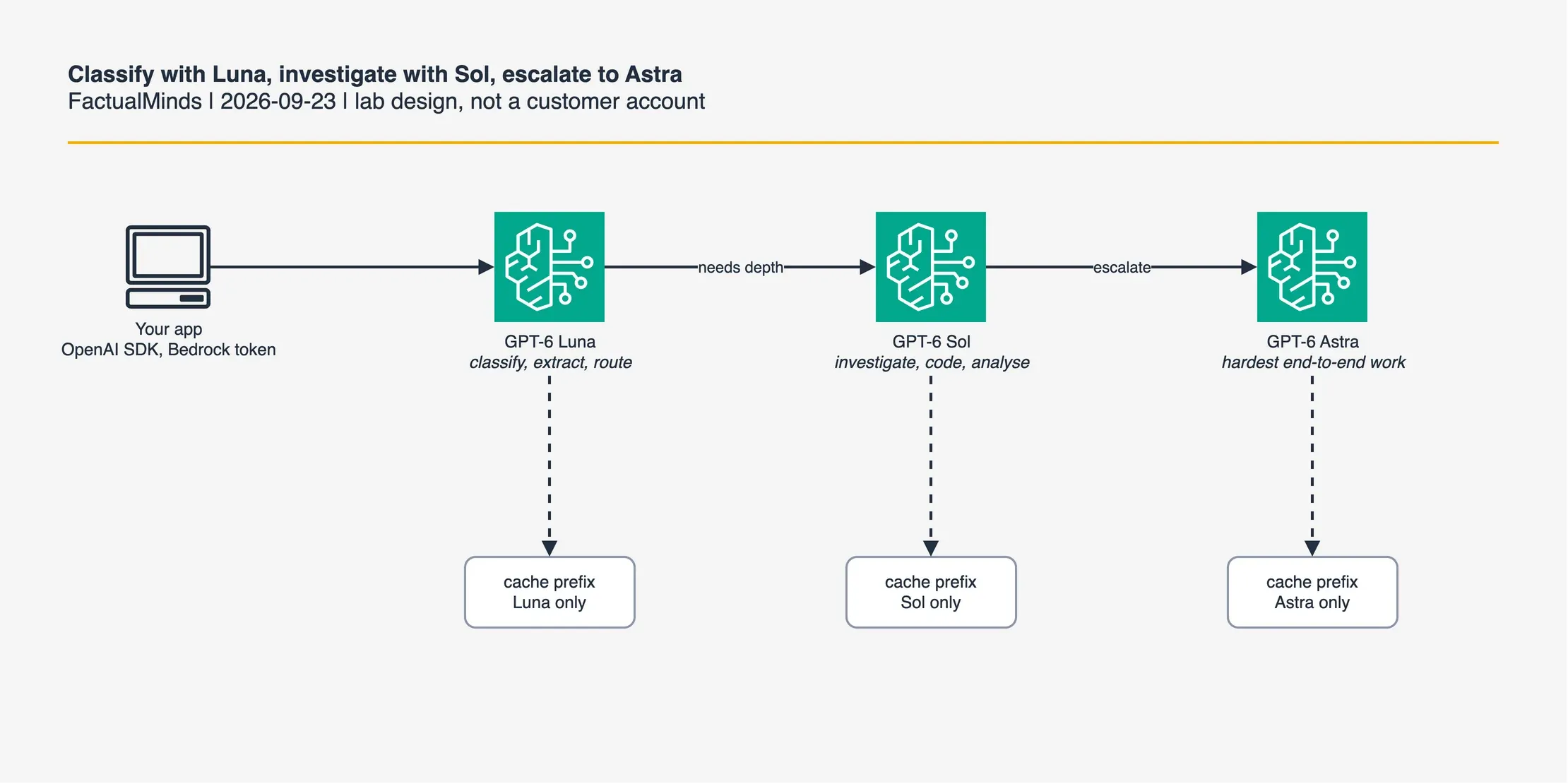
Figure: Luna classifies, Sol investigates, Astra takes the escalations. Each model keeps its own cached prefix, because cache identity is per model. Open the draw.io source.
Do not share one cache prefix across the three models. Cache identity is per model. A Luna checkpoint is not a Sol hit.
Prices: what is published, and what is not
AWS says Sol and Luna come at significantly lower API pricing than GPT-5.6 and does not print a rate card in the what’s-new post or the ML blog.
OpenAI’s API docs (first-party, not a Bedrock invoice) list, per 1M tokens:
| Model | Input | Cached input | Cache write | Output |
|---|---|---|---|---|
| GPT-6 Sol | $2.00 | $0.20 | $2.50 | $10.00 |
| GPT-6 Luna | $0.10 | $0.01 | $0.125 | $0.50 |
Prompts over 272K input tokens are 2× input and cache rates and 1.5× output for the whole request. Regional processing adds 10%. OpenAI’s Bedrock guide says commercial Bedrock pricing matches OpenAI direct pricing, and a region-specific Bedrock service is priced like OpenAI Regional processing. The Bedrock pricing page lists GPT-6 Sol and Luna as selectable models. The static extract on September 23, 2026 did not include their dollar rows. Confirm the selector before you re-forecast.
GPT-6 Astra does publish Bedrock Standard-tier rates on its model card. Short context (272K input tokens or fewer), per 1M tokens:
| Inference | Input | 30-minute cache write | Cache read | Output |
|---|---|---|---|---|
| Global CRIS | $10.00 | $12.50 | $1.00 | $50.00 |
| In-region and geo CRIS | $11.00 | $13.75 | $1.10 | $55.00 |
Long context (more than 272K input tokens) doubles input and cache rates and prices output at 1.5× ($75 global, $82.50 in-region). Priority and Flex are not supported for Astra. The card says in-region prices already include the 10% fee over OpenAI rates.
Previously published GPT-5.6 Bedrock on-demand pins ($0.22 / $1.32 Luna, $5.50 / $33 Sol) stay in our calculators. We are not replacing them with derived GPT-6 rates.
Data controls AWS names
- IAM for access, CloudTrail for every invocation, PrivateLink for VPC-only traffic.
- Inference runs on hardware-isolated infrastructure with zero-operator access.
- Inference data is not used for training, and you do not opt in to sharing it with OpenAI.
- Classifier-flagged abuse-detection traffic is retained by AWS for up to 30 days and processed programmatically. Zero data retention is a request through your account team.
That is a different default from Claude Opus 5.5, where AWS says ZDR is on by default on Bedrock. If the lane’s requirement is ZDR without an account-team exception, do not move it to GPT-6 because the coding eval looks better.
What to do this week
- Inventory production callers still pinned to
openai.gpt-5.6-luna,openai.gpt-5.6-terra, andopenai.gpt-5.6-sol. - Add Sol and Luna in a non-prod account. Smoke-test Mantle in us-east-1 and one Runtime profile (
us.orglobal.). - Pick one high-volume lane and one coding lane. Freeze the prompts. Score quality, latency, and cost per completed task against the GPT-5.6 pin.
- Turn on explicit prompt caching only for prefixes you can prove are identical across requests.
- Add GPT-6.1 Sol to the coding-lane bakeoff against GPT-6 Sol. Non-US callers can use
global.openai.gpt-6.1-sol. Ultrafast ("service_tier": "ultrafast") is the latency tier at 6× Standard, not a different model. - Put GPT-6.1 Terra into the bakeoff for any lane now on GPT-5.6 Terra or GPT-6.1 Sol. Before the first call, add
bedrock:InvokeModelon the default project ARN to the caller’s IAM policy. - Block a production default change until the Bedrock price selector shows a rate you are willing to budget, and until the bakeoff passes.
What this post doesn’t cover
- A Bedrock dollar rate for Luna. Sol’s Bedrock rates are in the September 30 update above; Luna’s were not captured. OpenAI first-party rates are labeled as such above.
- A first-party FactualMinds bakeoff. The “half as many mistakes” figure is OpenAI’s internal factuality eval, not ours.
- A GPT-6.1 Luna. None has shipped as of October 27, 2026. GPT-6 Terra never shipped; GPT-6.1 Terra is the first GPT-6-family Terra.
- A first-party test of GPT-6.1 Terra. The Agents’ Last Exam and speed figures are OpenAI’s.
- Codex or Managed Agents packaging. See the April OpenAI-on-Bedrock note.
Related reading
- GPT-5.6 Luna and Terra Bedrock Price Cuts (July 2026)
- Claude Opus 5.5 on AWS Bedrock (September 2026)
- OpenAI Models, Codex, and Managed Agents on Bedrock
- AWS Bedrock vs OpenAI API for Enterprise
- AWS Bedrock Cost Optimization: Token Budgets and Model Selection
Frequently asked questions
Are GPT-6 Sol and GPT-6 Luna generally available on Amazon Bedrock?
What are the Bedrock model IDs for GPT-6 Sol and Luna?
How much do GPT-6 Sol and Luna cost on Bedrock?
Should we replace GPT-5.6 Luna and Sol immediately?
What changed with GPT-6.1 Sol (September 29, 2026)?
Can I use GPT-6.1 Sol from outside the United States?
What is GPT-6.1 Terra and what does it cost on Bedrock?
Does GPT-6 on Bedrock train on my prompts?

AWS Cloud Architect & AI Expert
AWS-certified cloud architect and AI expert with deep expertise in cloud migrations, cost optimization, and generative AI on AWS.