Scaling EdTech Platforms on AWS: Serverless Architecture for Education
Quick summary: July 2026: EdTech serverless on AWS covering exam-day spikes, SQS grading buffers, CloudFront video egress, and a readiness checklist so load tests match Monday 9am reality.
Key Takeaways
- July 2026: EdTech serverless on AWS covering exam-day spikes, SQS grading buffers, CloudFront video egress, and a readiness checklist so load tests match Monday 9am reality
- As of July 19, 2026, serverless still fits that shape if you model exam windows instead of average DAU
- Reprice Lambda, API Gateway, and especially CloudFront egress after any regional rate change; video often costs more than compute
- For the fuller 2026 LMS/assessment reference (SQS buffering, Aurora Serverless v2, Bedrock Guardrails), see EdTech on AWS (2026)
- Architecture diagram of a student request through CloudFront and API Gateway to Lambda and DynamoDB Figure: the LMS request in the article

Table of Contents
Education technology scales unlike retail: a platform with 500 summer users can hit tens of thousands on day one of term; a live exam can compress a week of quiz traffic into fifteen minutes, then go quiet over break.
As of July 19, 2026, serverless still fits that shape if you model exam windows instead of average DAU. Reprice Lambda, API Gateway, and especially CloudFront egress after any regional rate change; video often costs more than compute.
For the fuller 2026 LMS/assessment reference (SQS buffering, Aurora Serverless v2, Bedrock Guardrails), see EdTech on AWS (2026).
Why serverless for education
Serverless economics fit education workloads:
| Characteristic | Education Reality | Serverless Fit |
|---|---|---|
| Traffic variability | 100x difference between peak and off-peak | Scales from zero to any load automatically |
| Budget constraints | Education has limited IT budgets | Pay only for actual usage |
| Engineering team size | Small teams (3-10 engineers) | Zero infrastructure management |
| Availability requirements | Must not fail during exams and enrollment | Managed services with built-in high availability |
| Global access | Students worldwide, different time zones | CloudFront + edge computing for low latency |
A serverless architecture on AWS lets a 5-person EdTech startup deliver the same reliability and scale as a platform built by a 50-person engineering team.
Architecture pattern: modern LMS
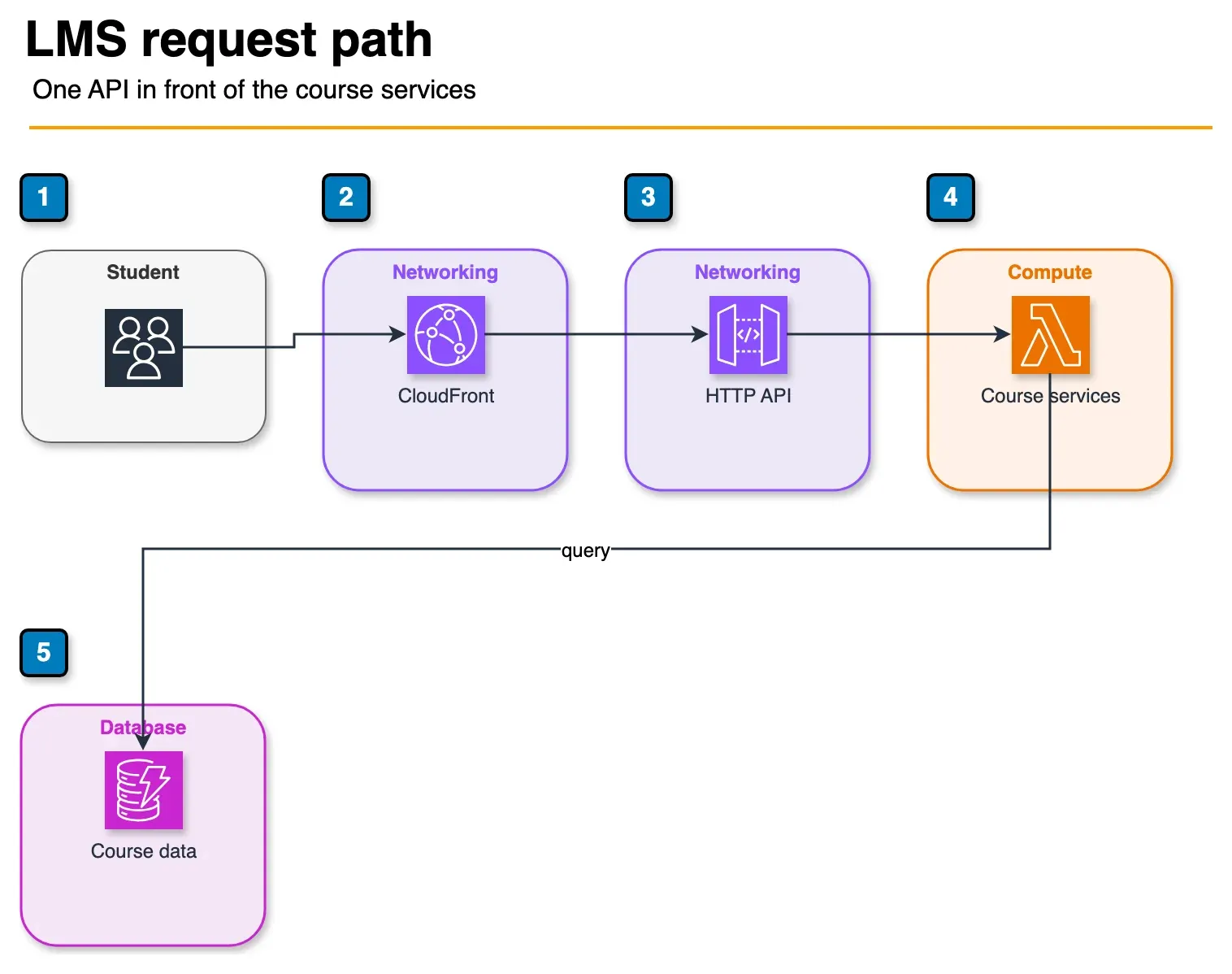
Figure: the LMS request in the article. CloudFront fronts an HTTP API, and Lambda serves the course services. Content files land in S3, and notifications use SES or Pinpoint. Those hops follow the same Lambda, so they are not a second sequence. Open the draw.io source.
Core Platform
Students/Teachers → CloudFront (CDN) → API Gateway (HTTP API) → Lambda Functions:
    ├→ Course Service      → DynamoDB (courses, enrollments)
    ├→ Content Service     → S3 (materials) + DynamoDB (metadata)
    ├→ Assignment Service  → DynamoDB (submissions) + S3 (files)
    ├→ Discussion Service  → DynamoDB (threads, posts)
    ├→ Gradebook Service   → DynamoDB (grades, rubrics)
    └→ Notification Service → SES (email) + Pinpoint (push)
Why DynamoDB: Education platforms have well-defined access patterns: get courses by student, list assignments by course, retrieve grades by student and course. These patterns map well to DynamoDB’s single-table design, providing single-digit millisecond latency with zero database management.
Why HTTP API: API Gateway HTTP API is 70% cheaper than REST API and adds lower latency. For most LMS endpoints, the simpler HTTP API provides what is needed: routing, authorization (JWT validation), and throttling.
Real-time features
Student Actions → API Gateway (WebSocket) → Lambda → DynamoDB
                                                    → EventBridge → Lambda → Connected Clients
WebSocket connections via API Gateway enable:
- Live collaboration: Multiple students editing a shared document
- Real-time discussions: Chat-style discussion boards during lectures
- Live notifications: Instant grade posting, assignment due date reminders
- Presence indicators: Show who is currently online in a course
Architecture pattern: live assessment system
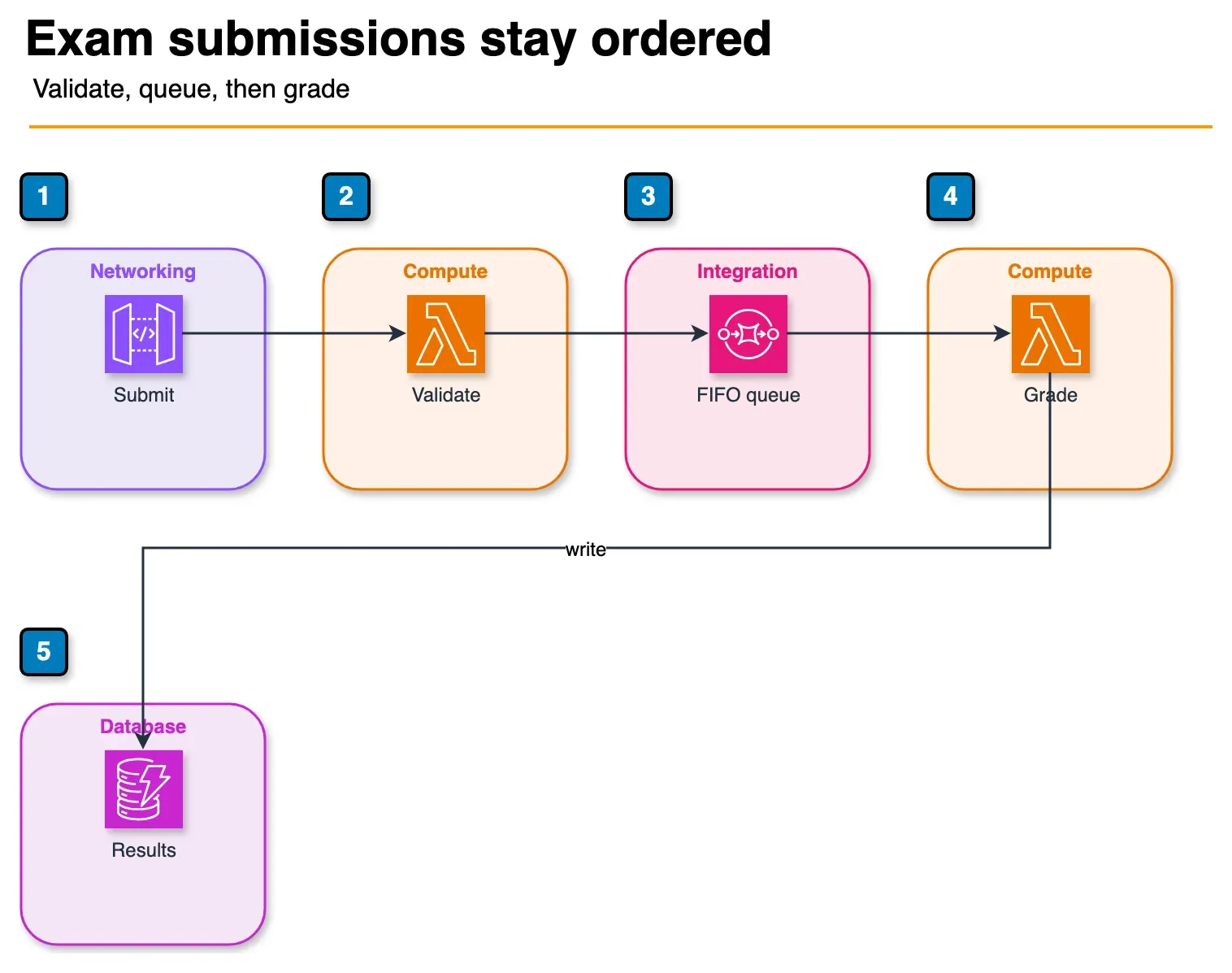
Figure: the live-assessment pipeline in the article. The first function validates and timestamps. SQS FIFO keeps one student’s submissions ordered. The grading function writes results to DynamoDB. Streams and analytics stay in the article. Open the draw.io source.
This is the highest-stakes workload in education: thousands of students submitting answers simultaneously during a timed exam.
Submission pipeline
Student Submit → API Gateway → Lambda (validate + timestamp) → SQS FIFO (ordered by student)
                                                                        ↓
                                                                Lambda (grade) → DynamoDB (results)
                                                                        ↓
                                                                DynamoDB Streams → Lambda → Analytics
Design decisions:
- API Gateway + Lambda accepts submissions instantly. Lambda scales to thousands of concurrent executions automatically, so no student experiences a timeout during a peak submission window
- SQS FIFO provides exactly-once processing and ordering guarantees per student (using student ID as the message group ID). If a student submits twice (network glitch), deduplication prevents double-grading.
- DynamoDB stores results with single-digit millisecond write latency. Students see their score immediately after the exam closes.
Auto-scaling exam capacity
This serverless architecture handles 10 students or 100,000 students without any configuration changes:
| Concurrent Students | Lambda Instances | SQS Processing | DynamoDB |
|---|---|---|---|
| 100 | ~10-20 | Near-instant | On-demand scales automatically |
| 1,000 | ~100-200 | Seconds | On-demand scales automatically |
| 10,000 | ~1,000-2,000 | Seconds | On-demand scales automatically |
| 100,000 | ~5,000-10,000 | Minutes | On-demand scales automatically |
You do not pre-provision or plan capacity before a major exam.
Architecture pattern: video content delivery
Lecture recording and streaming
Instructor Uploads → S3 (source) → EventBridge → MediaConvert (transcode):
    ├→ HLS adaptive streaming (480p, 720p, 1080p)
    ├→ Thumbnail generation
    └→ Audio extraction (for podcasts)
        ↓
    S3 (transcoded) → CloudFront (signed URLs) → Students
        ↓
    Transcribe (auto-captions) → S3 (VTT files)
Key features:
- Adaptive bitrate streaming: MediaConvert creates HLS playlists with multiple quality levels. Students on slow connections get 480p; fast connections get 1080p. The player switches automatically.
- Signed URLs: CloudFront signed URLs ensure only enrolled students can access course videos. URLs expire after a configured duration.
- Auto-captioning: Amazon Transcribe generates closed captions automatically, which matters for accessibility compliance (ADA, Section 508) and for non-native English speakers.
- Global delivery: CloudFront caches content at edge locations worldwide. A student in Tokyo and a student in London both experience fast video loading.
Cost optimization for video
Video storage and delivery is typically the largest EdTech cost:
- S3 Intelligent-Tiering: Videos from previous semesters automatically move to cheaper storage tiers. Current semester content stays in standard access.
- CloudFront caching: Popular videos (introductory lectures) are served from cache, avoiding S3 retrieval costs. Cache hit rates of 90%+ are common for educational content.
- MediaConvert on-demand: Pay only for transcoding time. There is no always-on infrastructure for a task that happens once per video upload.
- Lifecycle policies: Delete transcoding source files after processing. Keep only the transcoded output.
Architecture pattern: AI-powered learning
AI tutoring assistant
Student Question → API Gateway → Lambda → Bedrock (Claude Sonnet 5.5 recommended as of September 2026):
    ├→ System prompt (course context, learning objectives, student level)
    ├→ Conversation history (DynamoDB)
    ├→ Course materials (RAG with Knowledge Bases for Bedrock)
    └→ Guardrails (age-appropriate, on-topic, no answer-giving)
        ↓
    AI Response → Lambda (log, analyze) → Student
Amazon Bedrock enables AI features that small EdTech teams could not build before:
- Personalized tutoring: AI that adapts explanations based on student comprehension level and learning history
- Practice problem generation: Generate unlimited practice problems with varying difficulty based on curriculum standards
- Essay feedback: Structured feedback on student writing with specific improvement suggestions (without giving answers)
- Content summarization: Generate study guides from lecture transcripts and course materials
Education AI needs guardrails:
- Block responses that give direct answers to homework/exam questions
- Filter age-inappropriate content
- Keep conversations focused on course material
- Prevent hallucinated citations or incorrect factual claims
Learning analytics
Student Interactions → Kinesis Firehose → S3 (data lake) → Glue ETL → Athena/QuickSight:
    ├→ Engagement metrics (time on task, completion rates)
    ├→ Performance trends (assessment scores over time)
    ├→ At-risk indicators (declining engagement, missed assignments)
    └→ Content effectiveness (which materials correlate with better outcomes)
Data analytics enables evidence-based education by identifying which teaching approaches work, which students need intervention, and how to improve course design based on actual learning outcomes.
Student data privacy
FERPA compliance checklist
- AWS BAA signed for FERPA-eligible services
- All student data encrypted at rest (S3 SSE-KMS, DynamoDB encryption, RDS encryption)
- All data in transit over TLS 1.2+
- IAM roles with least-privilege access to student data
- CloudTrail logging all access to student data stores
- Data retention policies matching institutional requirements
- Student data deletion capability (right to be forgotten)
- Access controls preventing unauthorized staff access
- Vendor data processing agreements for any third-party services
COPPA for K-12 Platforms
Platforms serving children under 13 must implement additional protections:
- Verifiable parental consent before collecting student data
- Data minimization: collect only what is necessary for the educational purpose
- No behavioral advertising using student data
- Parental access to view and delete their child’s data
- Clear privacy policy in accessible language
For data security and compliance architecture, see our security services.
Cost analysis: serverless EdTech platform
Monthly cost for a platform serving 10,000 active students:
| Service | Usage | Monthly Cost |
|---|---|---|
| Lambda | 50M invocations, 200ms avg duration | ~$95 |
| API Gateway (HTTP API) | 50M requests | ~$50 |
| DynamoDB (on-demand) | 100M reads, 20M writes | ~$150 |
| S3 (5 TB course content) | Storage + requests | ~$120 |
| CloudFront (10 TB transfer) | Video delivery | ~$850 |
| MediaConvert | 100 hours transcoded/month | ~$200 |
| SES (notifications) | 500K emails | ~$50 |
| CloudWatch (monitoring) | Logs + metrics | ~$50 |
| Total | ~$1,565/month |
During summer break with 500 active students, the same platform might cost $200 to $300/month. Lambda, DynamoDB, and API Gateway costs drop proportionally with traffic, and only S3 storage stays constant.
Cost rows above are illustrative mid-2026 order-of-magnitude for one fictional 10k-MAU profile. Recompute with AWS Pricing Calculator for your Region and video GB.
What this post doesn’t cover
- K-12 device management / MDM: outside this architecture note.
- Full FERPA legal advice: use the FERPA boundary matrix as an engineering prompt, not counsel.
- On-prem LMS lift: see migration readiness posts.
What to do this week
- Re-run load tests with exam-window concurrency instead of average DAU.
- Put SQS (or equivalent) in front of grading writes; confirm DLQ alarms.
- Split CloudFront egress from Lambda in Cost Explorer for last term’s peak week.

Enterprise AI Transformation
Enterprise AI transformation and implementation leader focused on pilot-to-production playbooks, with a background in financial services. Writes the FactualMinds guides on serverless, CI/CD, and DevOps on AWS, the delivery plumbing production AI depends on.