Tagged

cost-optimization

Tagged articles
105
5 min

AWS CloudTrail Pricing: Why Data Events Drive the Bill

Management events are free for the first trail. Data events bill $0.10 per 100K, and on a busy S3 bucket that lands at thousands per month. CloudTrail Lake is $0.75/GB ingested with one-year extendable retention ($0.023/GB-month after year one), or $2.50/GB with seven years of retention included. Insights events analyze every management event for anomalies at $0.35/100K. Wildcard data-event selectors are the usual source of the overspend.

Kevin W.
4 min

Post-Migration Optimization and the FinOps Handoff (2026): The First 30 Days After Cutover Decide Your Run-Rate

A lift-and-shift migration copies on-prem specs sized for peak plus headroom, then the migration partner rolls off and nobody owns the bill. The waste is predictable: 30 to 60% of cost untagged, over-provisioned EC2/RDS, idle NAT Gateways and orphaned EBS, and commitments bought on top of all of it. This is the explicit migration-to-FinOps handoff: owner first, visibility second, right-size before you commit. It comes with a 30-day checklist and an optimization-backlog CSV.

Kevin W.
8 min

Observability Beyond CloudWatch (2026): When to Add Application Signals, ADOT, Managed Prometheus, and Grafana — and When Not To

The reflex to bolt Amazon Managed Prometheus + Grafana onto every workload is how observability bills quietly double. CloudWatch Application Signals now gives you an auto-discovered service map, SLOs, and traces with near-zero setup; AMP only earns its keep when you are PromQL-native or drowning in high-cardinality metrics, where ingestion (not retention) is the cost driver. The post covers the decision matrix, an ADOT dual-export config, and the three levers that actually cut the AMP bill.

Manoj V.
7 min

AWS KMS Encryption Architecture (2026): The Per-Tenant CMK Trap, the 10,000 req/s Shared Quota, and When AWS-Owned Keys Win

Most KMS guides stop at "enable encryption." The architecture decision that actually bites is the key boundary: split one CMK into 3,200 per-tenant keys and you pay ~$3,200/mo in key storage alone while still sharing a single 10,000 req/s symmetric quota. The post covers the decision matrix, the throttle math, and the encryption-context pattern that gives per-tenant isolation without per-tenant keys.

Nash Ogden
6 min

AWS Tagging, Chargeback, and FinOps Ownership (2026): Tag Policy vs SCP, the Untaggable 21%, and Splitting Shared Cost Without a Spreadsheet War

Tag policies report; only an SCP prevents untagged spend. And ~21% of a typical bill (egress, inter-AZ transfer, Enterprise Support, shared platform services) carries no tag any tool can read. The post covers the two-layer enforcement model, the Cost Categories split-charge rules that replace the monthly allocation spreadsheet, and why you show back before you charge back.

Kevin W.
8 min

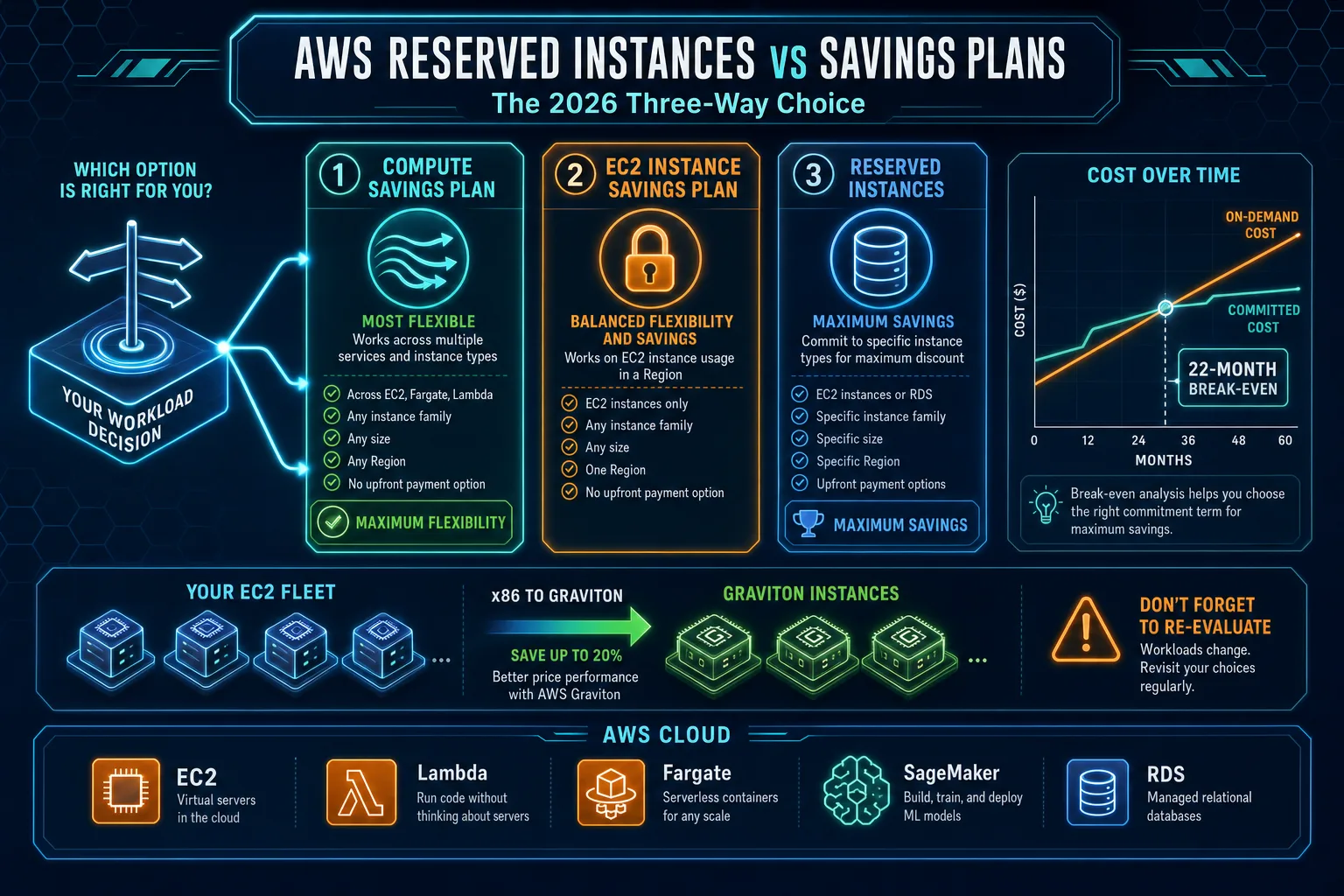
Reserved Instances vs Savings Plans on AWS (2026): The Three-Way Choice, the 22-Month Break-Even, and When to Skip Commitment Entirely

Most "RI vs Savings Plan" content treats them as peers. In mid-2026 they are not. A 3-year All-Upfront Compute Savings Plan saves a composite ~$60k/mo SaaS roughly $864k over 3 years vs a 1-year No-Upfront plan, but breaks even at ~22 months and locks instance-family flexibility. Buy the wrong commitment and a Graviton migration strands the discount. This post gives the decision tree we use.

Kevin W.
4 min

AWS Global Accelerator vs CloudFront & Route 53 (2026)

Global Accelerator charges about $0.025 per provisioned accelerator per hour, even while disabled, and adds Data Transfer-Premium on top of normal data transfer. Two static Anycast IPv4 addresses (or four addresses in dual-stack: two IPv4 and two IPv6) front ALBs, NLBs, EC2, or EIPs across Regions; that pricing model changes whether you beat CloudFront or Route 53 latency records alone.

Palaniappan P